Truthenomics #9: Famine incoming
How does the closure of the Strait of Hormuz impact our capacity to grow food?
How does the closure of the Strait of Hormuz impact our capacity to grow food?

Us Aussies shouldn’t be surprised by our State Governments invoking emergency powers the week before Easter to ‘compel the fuel industry to provide full visibility of fuel chain supply’. Australia dangles at the arse-end of the world’s fossil fuel supply chain. With only 30 days of fossil fuel reserves - the lowest amount in the OECD - the Middle East conflict has our fuel supply security looking rather sketchy.
Iran all but closing shipping through the Strait of Hormuz means crude oil extracted by the Middle East exporters can’t reach East and South East Asian oil refineries. These refineries supply about 80% of Australia’s petrol, diesel and jet fuel. Even if Iran opens the Strait tomorrow, it will be months before supplies return to anywhere near ‘normal’.
In the meantime, we can expect our main suppliers, South Korea, Singapore and China, to reserve most of the fuel they refine for themselves. This leaves Australia in a bidding war with the rest of the world for fossil fuel ‘leftovers’. As a rich country, Australia is likely to outbid poorer countries for fuels and scrape by; with or without overt rationing and government directed prioritisation of who gets what fuel.

However, for many poorer countries, being outbid for transport fuel may be the least of their worries. Famine looms as a greater concern. This is because of the way the modern world produces food. In reality, our modern agricultural systems don’t grow food. We mine it. That is, our food supply critically depends on mined nutrients and mined fossil fuels.
Food mining
The world’s current population of nearly 8.3 billion is unsustainable without access to the inputs that power industrial agriculture. That is, agriculture undertaken at scale, using mechanised rather than human or beast powered methods of growing and distributing agricultural produce. This can only happen if industrial agriculture can source the energy needed to power its tractors, trains, trucks, ships and ploughs. Some 25-30% of the cost of food that reaches our plates is energy costs. Most of that energy comes from burning fossil fuels.
Sourcing and replacing the nutrients removed by every crop or beast taken from the land on which it has grown is equally important. Whether it is pastures given over to beef grazing or croplands growing grain to make bread, nothing grows without three major nutrients needed by plants to convert sunlight energy into food: nitrogen, phosphorus and potassium.

The high-yielding grain cultivars grown by industrial agriculture need these three nutrients in bulk to be productive. Across the planet, some 200 million tonnes of fertilisers, about half nitrogen and a quarter each of phosphorus and potassium, need to be distributed annually to maintain high yields and keep us all fed.
The supply and use of phosphorus is illustrative. The nearly 50 million tons of phosphorus fertilisers needed each year is mined from sedimentary phosphate rock deposits. The largest reserves of which are located in Morocco and the Western Sahara region. These regions export mined phosphate worldwide. China, the USA and Russia are other large producers but hold smaller reserves.
The annual replenishment of soil phosphorus is a massive logistical undertaking. Essentially every machine used in the process, from mining equipment, the ships carrying the phosphate rock and processed fertilisers to the tractors pulling the ploughs and the fertiliser spreaders are powered by fossil fuels.
The story for potassium is similar to that of phosphorus. Potassium salts are mined in many countries but only a handful supply the bulk of the world’s needs. These being Canada, Russia, Belarus and China. A significant difference to phosphorus is that transforming mined potassium salts into a market-ready fertiliser is more energy intensive.
Nitrogen fertiliser production is the most energy intensive of the three to produce and is critically dependent upon fossil fuels, particularly natural gas. The commonest process takes hydrogen from natural gas to combine it with atmospheric nitrogen to yield ammonia. Almost all nitrogen fertilisers are synthesised from ammonia.
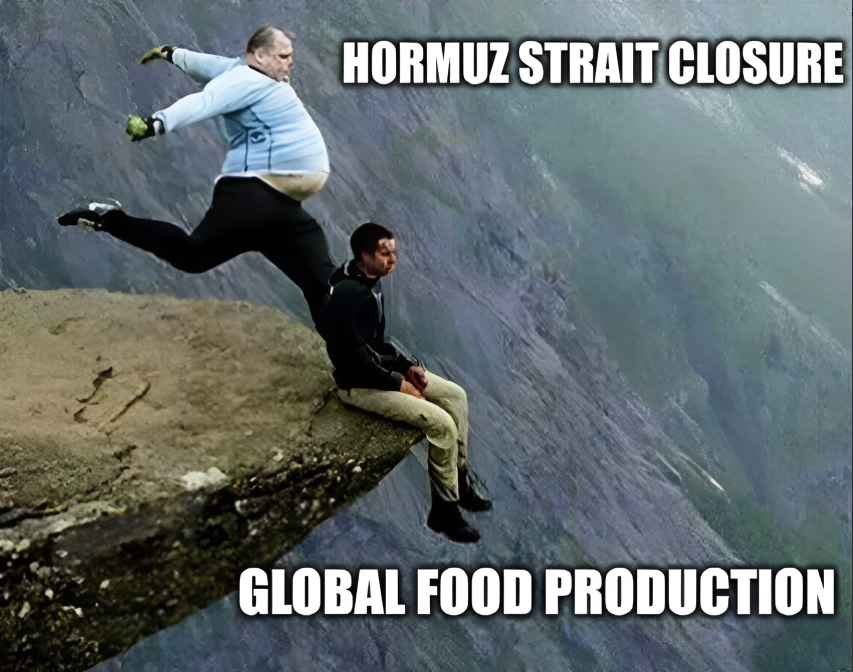
The Gulf States are amongst the largest producers of nitrogen fertilisers. About one third of the world’s supply of nitrogen fertiliser is currently trapped in the Persian Gulf by the Hormuz Strait closure. Of the world’s other large producers, South Asian producers have curtailed production due to restricted liquid natural gas supplies and both China and Russia have all but ceased nitrogen fertiliser exports. This is of grave concern at this time of year. The month of April marks the start of the northern hemisphere summer growing season and the winter grain growing season here in Australia. In both hemispheres, farmers are struggling, not only with diesel supply and costs, but also fertiliser supplies. Again, the rich are outbidding the poor for the supplies that are available.
What happens if the war continues?
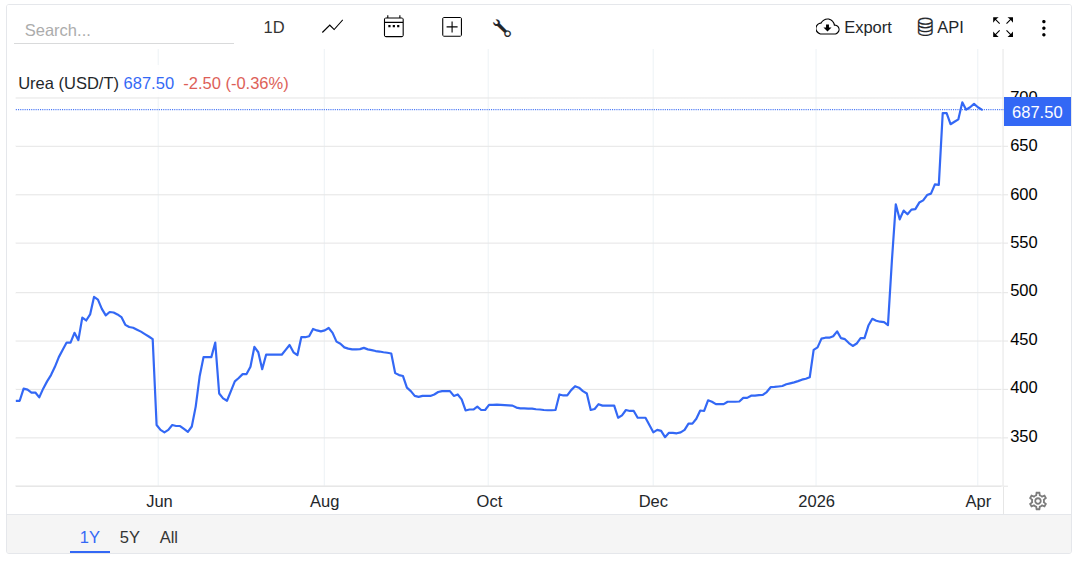
Prices for urea, the most widely used nitrogen fertiliser, have already risen 70% since the start of the year. With no end in sight to the conflict, we can expect prices to increase further. Similarly high fertiliser prices in 2007-2008, due to high oil prices at the time, sparked a worldwide food price crisis and social unrest in many poorer countries. Now, as in 2007-2008, poorer farmers of the Global South, unable to access affordable fertilisers and fossil fuels this growing season, face ruin and/or starvation. Social unrest is likely to follow.
Is organic farming the answer?
As much as it would be desirable, a rapid transition to feeding billions via more sustainable farming practices is simply not achievable today. Most of the plant nutrients we mine or manufacture to grow food go ‘down the toilet’ via the world’s cities’ sewerage systems. Developing the technologies to effectively extract and recycle phosphate, potassium and nitrogen from metropolitan city sewerage systems is in its infancy.
Yes, there are localities that already collect, disinfect and process human waste at scale and return the output, euphemistically labelled ‘biosolids’, to farmlands. However, building the logistics networks to package, transport and distribute all that plant nutrient from large cities back across oceans or continents to where food is grown is a multi-decade undertaking. And yes, we should use the current crisis to provide impetus to begin scaling such efforts.
In the meantime, the unfolding crisis behoves all of us to think carefully about our energy, fuel and other forms of consumption and how we might help others less fortunate than ourselves, both here and in other countries worse affected by the current conflict.
Subscribe to thisnannuplife.net FOR FREE to join the conversation.
Already a member? Just enter your email below to get your log in link.